
Disclaimer: This post is long. Every subsection probably could have been its own post, but let’s be real – people don’t really like series, and I’m absolutely terrible at remembering I’ve even started one. So instead, here it is all at once: pretty much everything I’ve been holding about anger, in one place.
I’ve been doing really well with anorexia recovery, even though I hate it most of the time. I’ve now reached a healthy weight – if you believe in BMI charts anyway (I don’t, but it’s the easiest way to explain where I am without a triggering number, I am still below my set point).
Since reaching this point, I’ve been flooded with “recovery realisations”, forced to face all the reasons I relapsed. One of them is anger. Anger that came screaming back as if hitting this weight flipped a switch and brought the real me crashing back – the me I once starved to escape. Now she’s here again, and I have to sit with her, not starve to run away from her.
Anger and WeeGee
When my best friend WeeGee died, my first grief response wasn’t sadness – it was anger. I was angry at everything: angry that she was gone, angry at Boris “bin bag full of custard” Johnson’s handling of the pandemic, angry at the AstraZeneca vaccine, angry at the NHS, angry at people who refused to wear a mask. Suddenly I was even angrier at my mother for abusing me and my son our whole lives. I was just angry in general, all the time.
I recognised anger as a “stage” of grief, but I didn’t pass through it. It felt like I’d pitched a tent there and stayed, until I worried my entire personality had just become “angry person.”
Social media made it worse. Facebook and Instagram amplified every injustice, and any spark of rage in me became a house fire. I left those platforms because I couldn’t contain it anymore, no matter how many times I tried. I know now, part of me was waiting for WeeGee there. Hoping I’d see her post, hoping for a sign of life. I’d get angry when I never found a sign that she was coming back.
And I hated myself for it. I’ve always felt allergic to anger. This time it wasn’t just about how I thought anger looked – it was about honouring WeeGee. She was the least angry person I ever knew. She had the same passion for injustice, but she translated it into diplomacy and thoughtful (but CAPS LOCK) blog posts that made people think, not rage. She could make you question why the world was broken with caps lock humour, love and hope.
So I kept thinking: she wouldn’t want me angry. That I was ruining her memory by raging, that maybe she wouldn’t even like me anymore. I thought I should be honouring her with tears, with staring out rainy windows, not with Facebook rants about Covid conspiracies – which, by the way, weren’t even conspiracies at all. The UK Covid Inquiry proved most of what I ranted was true. I wish I’d been wrong. But at the time, I thought I was just shouting my mouth off, until I hated myself enough to leave Facebook entirely.
I tried other coping mechanisms. I left triggers behind, tried distraction, but the anger wouldn’t go. And I couldn’t accept that I was turning into this new, unfamiliar, angry version of myself. I’ve always had fire (I’m Welsh, it’s in the DNA), but this was fire dialled up to over 9000. Nothing I did could cool it.
My anger only ever pointed outward at systems, corruption, social media – not at individuals (except Boris “bin bag full of custard” Johnson and JK Rowling, but they’ll never read my rants, they only read things that agree with their agendas). But with myself? I never thought twice about aiming the fire inward. When I was angry, I punished myself without hesitation.
Not eating didn’t even feel like punishment. It felt logical. Of course I didn’t deserve food. Of course I should starve, because how dare I feel angry at all? That’s how my relapse began – not as a deliberate relapse, but as something that made so much sense in the moment that I didn’t even notice.
But starving away the anger didn’t just erase Angry Rhio – it erased all of Rhio. I became empty. And with that emptiness, I also lost the echoes of WeeGee in me. She changed me in so many good ways, and I gave that up too, because even the good changes reminded me of grief. What I really wanted was just the me I was when she was alive. I wanted all the good changes she gave me, without the changes her death forced on me.
And now Angry Rhio is back – but so are the echoes of WeeGee. If I want to keep those echoes alive, I have to sit with Angry Rhio too. I have to listen to her, break down with her, and resist the urge to punish her by not eating. That’s been one of the hardest parts of recovery, and one of the reasons I’ve hated it so much.
Anger and My Mother
My mother is the antithesis of WeeGee. Anger was the only real emotion she ever had – everything else was a mask, another way to control. Her anger was her favourite weapon: abusive, unpredictable, terrifying. She would flip without warning into a one-sided tirade of rage, for no reason at all.

Her outbursts were so common in my childhood that they felt almost normal. Until the day she did it to my son. He was just a toddler, crying, and her reaction was to scream at him in a red-faced fury that she didn’t love him anymore. My instant instinct was to comfort him. Hers was to wound. That was the moment I saw how not-normal it had ever been.
My entire life I’ve made it my mission not to be like her in any way. That’s why I’m so allergic to anger. When I feel it in myself – even justified anger – I panic. I get triggered back into that wardrobe I used to hide in as a child, terrified of her shouting and abuse. Only now there’s no wardrobe to hide in, because the angry person is me. The fear sounds like: oh no, I’m angry – what if I lose control like she did? What if I hurt my son? My immediate instinct is to smother it, to hide myself.
But the truth is, I’ve never once lost control. Not with my son, not even with her. I’ve shouted plenty at my mother, yes – but even then, my words were facts, not cruelty. Everything I’ve said, I’ve meant. I’ve never used anger as a weapon, never turned it into manipulation or abuse. But still, just being around angry people makes me cower. My body remembers her rage, and my nervous system reacts as if I’m unsafe.
When WeeGee died, I was suddenly living around an angry person all the time – myself. And in the same year, I finally went no contact with my mother. Losing WeeGee made me see the contrast so starkly: WeeGee gave me the unconditional love my mother never once offered me or my son. I was furious that my mother could walk around free, still harming, while WeeGee – the kindest, least angry person I’d ever known – had her life stolen.
The final straw was her escalating behaviour towards my son. I gave my mother chance after chance, and every time she proved she didn’t deserve them and proceeded to behave even worse. I should have cut her out of my life the day she screamed at my toddler son that she didn’t love him, but I didn’t. I let another decade of abuse pass.
Because to me… cutting her off felt mean. And in my mind, being mean was always worse than being hurt. That’s the lie I learned from her anger: that protecting myself – and protecting my son – was somehow cruelty.
Anger and Myself
That belief – that protecting myself is “mean” – has followed me into every boundary I’ve ever tried to make. I can state a boundary clearly, but when someone ignores it, I swallow it down instead of enforcing it. Because enforcing it feels cruel. It feels like I’ve turned into her.

So I let people run over my boundaries for years, and the resentment builds. I tell myself: why can’t they just respect what I said the first time? Why do I have to enforce it at all? The truth is, enforcing a boundary isn’t cruelty. But because of her, it feels like it is.
WeeGee never made me feel this way. I never had to enforce a boundary with her. I could state one, and her actions would simply say, okay. That’s why I trusted her so deeply – she didn’t need me to fight for respect. She just gave it. I wish people were all like WeeGee. It makes me so angry that they’re not.
I can clearly state a boundary and still be walked over, and when that happens, the anger cuts both ways: I’m furious at them for ignoring it, and furious at myself for being “forced” to enforce it. Somehow it always ends up being on me, not them.
The only exception has been my son. I’ve been the security guard of his boundaries, always. And I’ve noticed: when I let people walk all over mine, they think they can do the same to him and are absolutely shocked that I wont let them.
What I hate most is the way people react when I do enforce his boundaries. I can be calm, not even raise my voice, and still get told I’m “irrational,” “overprotective,” “mentally ill”. All because I said, “that’s not okay”. It’s never about the way I said it – it’s about the fact I said it at all. That’s the usual playbook when choosey beggars get denied access – I know it by heart. None of those people are in our lives anymore. That’s the one boundary I don’t falter on. It’s the same reason I cut my mother out.
If it wasn’t for my son, I’d still be in her cycle of abuse. He gave me the courage to stop it – but I still should have acted sooner.
It doesn’t feel mean to enforce his boundaries. It feels right. It feels justified, protective, like teaching him how to grow up safe instead of abused. But mine? Mine always feel mean. Mine always feel like her. And so I’ve let people walk all over me in the name of “keeping the peace,” even though not one of them ever cared about my peace at all.
And that’s the part that cuts the deepest: when it comes to me, anger always feels like proof I’m a bad person. It doesn’t matter that I’ve never once used anger to control or abuse anyone. It doesn’t matter that even when I’ve shouted, it’s been facts, not cruelty. My brain still tells me: you’re just like her. And if I’m just like her, then I must be bad.
Why it Makes Me Feel Like a Bad Person
Anger has always felt dangerous to me. Not just dangerous to be around, but dangerous to be in me. My mother’s anger was abusive, controlling, and cruel, so somewhere along the way I learned that any anger must mean I’m like her. Even if I’ve never once used anger as a weapon, even if I’ve never lost control, my brain still whispers: you’re her. You’re bad.
So when I feel anger rise up, it’s not just the emotion I have to face – it’s shame. I feel like I’m failing. Like I’m already harming others simply by having the feeling at all. That’s when I punish myself, because it feels like the only way to prove I’m not her. If she used anger to hurt people, then I’ll use anger to hurt myself instead.
The irony is, that makes me feel even more like her – angry, destructive, unsafe. Even though the destruction is only ever aimed at me. I spiral into thinking I must be cruel, selfish, a bad mother, a bad person.
It’s also true that I treat myself the same way she treated me. Clippy (the name I give my ED) is my mother’s voice. She has said the same things: told me I don’t deserve food, sent me to bed hungry, reminded me how worthless I am. That’s why I call it Clippy and not me – because it frightens me to think it is me, when it sounds so much like her.
But the truth is, I’ve never been like her. I can say that clearly about how I’ve treated my son, and about how I’ve treated others. You don’t need to take my word for it – my son is autistic and blunt. If I was anything like my mother, he’d be shouting about it. He sussed her out himself without me ever telling him.
The only person I’ve ever turned my anger against is myself, and well video game enemies. And that’s not cruelty – that’s grief turned inwards, and digital molotovs.
Anger and Video Games
I’ve been playing a lot of Cyberpunk 2077 recently, hence the screenshots in my posts. People say video games cause violence, but for me they’re the opposite: a safe sandbox for anger. In games, I can use it and unleash it. I play Cyberpunk 2077 on Very Hard, no operating system, no mercy. An NPC disrespects me? Absolutely not. I’ve started in-game wars for less.
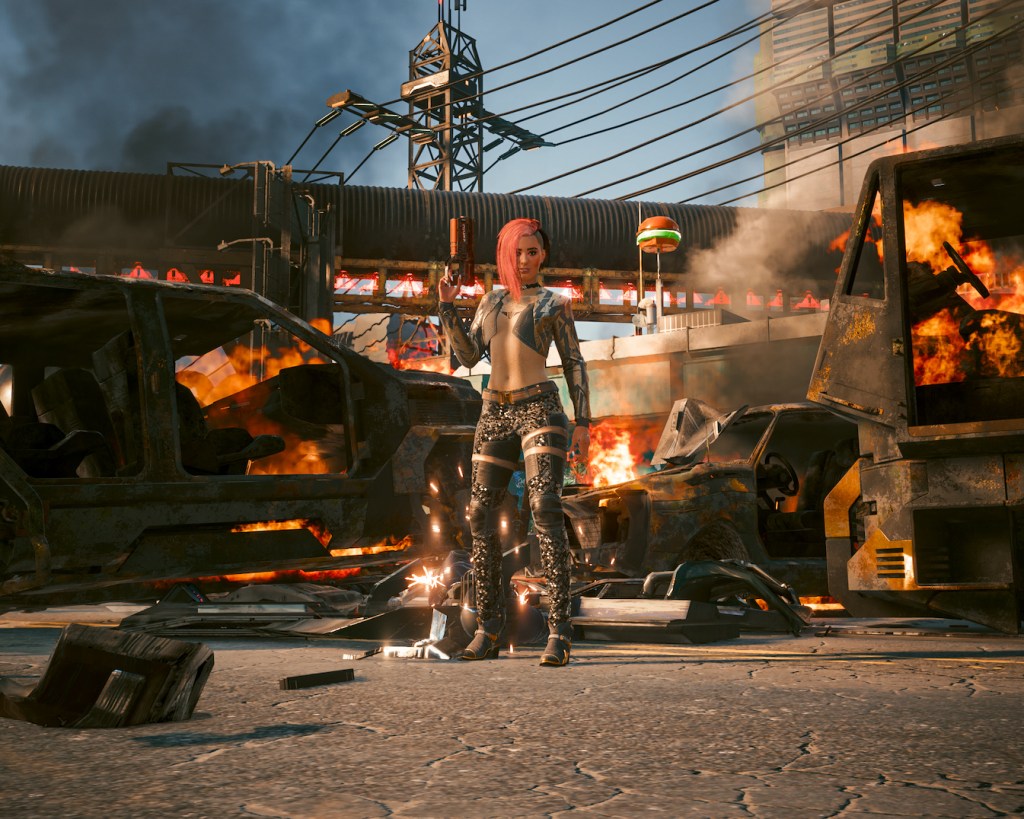
In Mass Effect, I’ve stepped up as a leader and saved the galaxy from a race of sentient machines intent on destroying all advanced life. I drop into these roles with ease, but they’re mirror versions of me. The real version couldn’t be more different.
It reminds me of Robert Daly from Black Mirror: USS Callister: timid, people-pleasing, swallowing my words, letting people walk all over me, laugh at me, treat me terribly. Yet in-game I’ll burn a whole Cyberpunk district down over pixelated disrespect. If a real person hurts me, I can’t even say so. I tell myself that would be “mean.” Maybe I was wrong to be hurt in the first place.
Games let me channel anger where it can’t hurt anyone. And this is where the Daly comparison ends: I don’t like hurting my pixelated crewmates, I don’t like making some of the NPCs sad. I’ve long wondered what will happen when game characters cross the line into real AI – whether it will still be ethical to start wars with them. But right now, games give me a safe space to swing weapons and light pixelated fires that don’t scar anyone permanently.
The truth is, I could do with being more like my game self in real life – less fire effects, sure, but more willingness to stand my ground. More ability to light fires metaphorically. The problem Robert Daly and I share is the same: using anger only in a sandbox world doesn’t change real life. His inaction kept him trapped and even more angry. And while I’m sure I won’t turn into a tyrant in video games like he did, mine has got worse too. I’ve caused my own anger to fester by inaction.
What I Plan To Do About It
Grief – I can’t starve my way out of it anymore. I have to let the anger come, let myself break down and cry, and still eat anyway. I’m still writing in my grief book, and I want to keep doing that. I also know some of my triggers now – like social media, where part of me is always searching for WeeGee, as if she’s just hiding and will come back. She won’t. And I need to stop punishing myself for looking or punishing myself for getting angry that I can’t find her.
My mother – I don’t have a neat answer here. She’s no longer in my life, and maybe that has to be enough for now. My work isn’t about changing her, it’s about untangling her voice from mine. That will probably take time.
Myself – I have to remind myself: I’m still early in recovery. My emotions have only just switched back on, so of course it feels chaotic. That doesn’t mean I’m “an angry person” – it means I’m a person in recovery, finally feeling. Maybe as grief softens, the anger will soften too.
Boundaries – This is the hardest part, but it’s the one I can’t avoid. I need to enforce boundaries, even when it feels mean. Especially when it feels mean. That’s not cruelty – it’s respect. I need more of my nan’s energy, who wore people’s hatred as proof she’d done something right: “Of course they hate me. I wouldn’t let them get away with murder, hah.” Maybe I need to start wearing that same pride.
Gaming – Gaming is a great outlet for anger about the things I can’t take action on in real life. For instance – what could I have done about the bin bag full of custard? Nothing. But going throwing-weapons-only on the mission “Don’t Fear the Reaper” in Cyberpunk 2077 is perfect for such an occasion.
The thing is, sitting with anger in a sandbox can’t be the only way I “deal” with it. Johnny Silverhand would call me a gonk for hiding out and getting run over by Night City scop: “You can’t jump out of a window, and then wonder why you got hurt, V.” He’d be right. It’s time to stop being a gonk, and start being a choom.
Where This Leaves Me
Anger is grief, and grief doesn’t go away because I starve it. It just festers. I can’t keep punishing myself for feeling it, and I can’t keep pretending it isn’t part of me.
Right now, all I can do is sit with it, feed myself anyway, and try not to run. Angry Rhio is here, and if I want to keep the echoes of WeeGee alive, then I have to live with her too. I have to feel the anger rise up and feel out of control, knowing it never has been.
For the song of the post, it had to be, “Never Fade Away” from the Cyberpunk 2077 soundtrack.
Johnny says, “Goodbye V and never stop fighting” just before it plays.
“I saw in you what life was missing
You lit a flame that consumed my hate
I’m not one for reminiscing but
I’d trade it all for your sweet embrace“
 Absurd Universe
Hi Serens. Thanks so much for your post. It’s equally heartbreaking, inspiring, heartfelt and motivational. I’m sorry for your loss with WeeGee’s passing and for what you and your son have been through. It sounds like the trauma in your life journey has been fuel to write things about. You write amazingly well and I wonder if you have considered writing a book. There’s plenty of people out there who would be inspired and maybe even would catch the eye of BJ or JKR, probably not but you never know!
LikeLiked by 1 person
Pingback: Pretty Painful Grief Letters Review – The Book That Sits With You in Grief – Seren's Bear Blog
Lovely post. I felt in empathy with you in this.
Anger needs to be acknowledged, as fully as we can, which maybe is the intention here?
I write it down too, in trying to make sense, and find a way through it.
LikeLiked by 1 person